“Banking is necessary; banks are not”
The quote of Bill Gates is somehow correct but also irritating. Banks have to change, and it depends on the willingness of an institution to change. If it does not do it, this quote makes total sense.
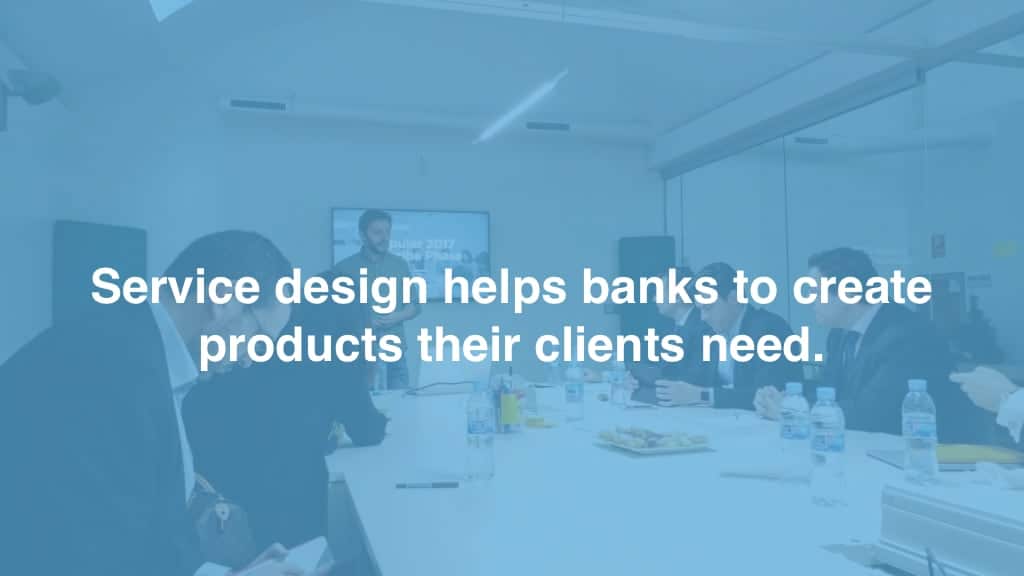
Service design for financial services has been central to that transformation – helping institutions move from inertia to genuine, human-centred change.
Financial services are not intermediaries that do nothing between a service and a service consumer. They offer something—authentic products and services that can make perfect sense for their customers if they fit their actual needs.
What’s happening in the customer – and employee – side of financial services?
The rise of fintech pushed financial services towards a customer-centric approach.
That shift is now being accelerated by AI – reshaping how decisions are made, how risk is assessed, and how customers are served.
Business structures that took decades to build are being challenged faster than most institutions can respond. And customers are different today: they ask for experience, transparency, and values. The journey is far from over.
Consumers need life-centred design
People are asking organisations to define success beyond financial growth.
Purpose and responsibility matter as much as returns.
And AI is accelerating this pressure – automated advice, algorithmic decisions, and personalisation are commoditising what was innovative just yesterday.
The bar for meaningful, transparent, and ethically grounded products is only getting higher.
Liquid expectations
Your customers are comparing their best experience with their worst one. They don’t care to compare apples with oranges. They compare Apple with you. They don’t bother about the complexity of processes.
Consumer preferences are shifting. A free account and an app no longer engage your customers.
AI-powered experiences have raised the bar further – whatever you deliver, it has to be simple, transparent, and without small print.
The ethics question
Organisations must proactively demonstrate what they stand for, whether they want to or not. People will choose a bank or insurance company that aligns with their beliefs.
Complying with SDGs by certification is not enough. Customers are demanding real action and sincerity.
And AI is making this more urgent – algorithmic decisions in credit, fraud, and personalisation carry real consequences.
Organisations that cannot explain how these decisions are made will face growing regulatory and reputational pressure.
In a time of geopolitical instability and deepening inequality, having a clear value proposition on how your organisation creates value is no longer optional.
How are your employees?
Transformation produces disengagement when people feel it is happening to them, not with them. Inclusivity, change management, and emotional safety are not soft topics – they are strategic ones.
This is especially true when change is driven by AI. The fear is not technology itself – it is losing relevance, purpose, or a job.
Organisations that involve employees in shaping how these tools are introduced will find far less resistance and far more resilience.
Employees are not afraid of change; they fear loss. Acknowledging this is where meaningful transformation begins.
Besides human needs, there are also organisational challenges.
Service design for financial services can tackle a wide range of organisational challenges – from serving the complex needs of segments like SMEs, to creating visibility and revenue for new products and services.
Industry disruption
How to handle disruption when it no longer comes from one direction?
Fintech normalised customer-centric thinking in financial services. AI is now going further – automating core functions, enabling new entrants to operate at scale with minimal infrastructure, and shifting customer expectations faster than most institutions can follow.
Buying or copying the competition buys time but does not transform the underlying approach. Service design helps build the capability to move from reactive to genuinely future-ready.
New entrants or competitors
If your client becomes unfaithful.
Clients act like water; they take the path of least resistance. Life has to be comfortable, and it is no wonder they demand products that fit their needs without friction.
The threat is no longer just fintech. AI-native competitors can now offer highly personalised, low-cost services with minimal overhead. Putting the customer at the centre is no longer a differentiator – it is the entry ticket.
Regulatory changes
When regulation starts driving your customer experience.
Most regulatory pressure on financial services is the result of poor customer administration and a lack of transparency about what was being sold.
Complex products and small print invited scrutiny. That scrutiny has not gone away – it has grown. AI regulation is now adding another layer, with institutions expected to explain and justify algorithmic decisions in ways they are often not yet equipped to do.
.
Damage to company reputation
When suddenly you are the bad guy.
Rebuilding customer perception is a slow and difficult task. The image people have of financial services was built over years – and damaged just as gradually, through accumulated mistrust.
More than a communications strategy, it requires fundamental transformation. That cannot be faked. It has to come from within the organisation. AI-related failures – biased decisions, data breaches, opaque processes – are now a new source of reputational risk that institutions cannot afford to ignore. Service design is the most effective approach to address this from the inside out.
How to tackle these topics?
A human/life-centred approach is the foundation for building lasting relationships with customers, partners, and employees. It is not a methodology – it is a mindset.
Changing the point of view on a problem always reveals something new. External perspective is not a weakness; it is a necessary correction to institutional bias.
Service design – through holistic research, co-creation, and design thinking – helps understand the real problem before reaching for solutions.
Increasingly, this also means working with foresight: reading signals early, understanding emerging pressures, and designing for futures that are not yet visible but already forming.
This is how you create solutions that are good for the organisation and for the world.
This is how you create solutions that are good for the world.
Human/life-centred design principles
With the Service Design methodology, we create services and products that are more efficient by making the optimum use of resources in a strictly human/life-centred approach.
Results
Service and products your customers will love because they need them.
Measurable indicators
#Revenue #Brand Reputation #Customer Retention.
Knowledge and a holistic understanding.
Fieldwork & Insights research
Unbiased knowledge is one of the principal concepts of service design and the base for each creation or transformation. It helps to craft better products and services and to increase the level of client and employee engagement and advocacy.
Results
Verify the problem statement and obtain unbiased knowledge and holistic insights.
Measurable indicators
#Brand Reputation #Revenue #Return on Invested Funds #Internal Rate of Return on a Project #Speed to Market.
Step aside from your ego.
Outside-in thinking
Service design encourages to empower empathy by providing a different point of view helps people to understand their position to make better decisions and to be better equipped.
Results
Improved customer experience and retention.
Measurable indicators
#Customer Retention #Customer Satisfaction, #Customer Advocacy (NPS) or Effort (CES )
Create together for strong and resilient solutions.
Co-creation
Co-creation helps to obtain consolidated results by tackling complex problems with diverse points of view, knowledge and multidisciplinary teams.
Results
Empathy, consolidated results and team building.
Measurable indicators
#Resilient Solutions over Time #Employee advocacy #Engagement Score #Workplace Reputation.
Relevant industry experience
- Banco Santander (Spain)
- NatWest Bank (UK)
- Zurich Insurance (Switzerland)
- Generali Insurance (Spain)
- Banco Popular ( Spain)
- Piraeus Bank (Greece)
- TSB / Sabadell bank (UK)
Let’s talk about how service design for financial services could help your organisation.
I’m glad you made it this far. That seems to be a good sign;
perhaps I can be of use to you.
I can help you with something or if you want to know more.
Frank Hoeft – designSTRTGY
Phone +34 677 22 95 75 (WhatsApp/Telegram/Signal)
Or write me a message here…